

Cargo E-Bikes: The USD 2 Billion Market Hiding in Plain Sight
Forecasts for the cargo e-bike market range from around $2 billion to nearly $5 billion by 2030. The exact number matters less than what the category represents: a bicycle becoming serious urban infrastructure.

Projections for the cargo e-bike market — ranging from around US$2 billion to nearly US$5 billion by 2030 depending on the forecaster and scope — reflect something larger than a product category. They mark the point at which a bicycle becomes load-bearing urban infrastructure, not just a consumer good.
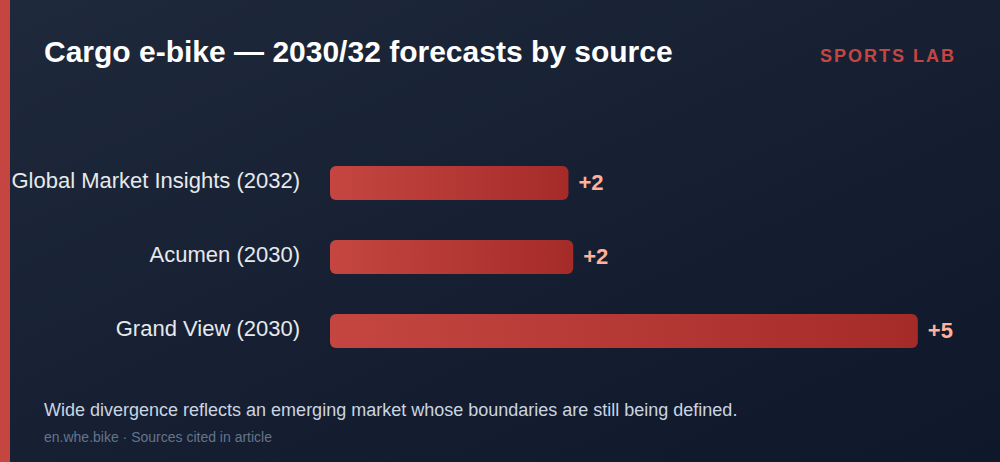
Cargo e-bike forecasts for 2030/32, by source.
Reading the forecast range honestly
The numbers vary widely because the market is still being defined. Research and Markets projects roughly US$2 billion by 2032; Mordor Intelligence estimates the market reaching US$2.8 billion by 2030 at a CAGR of 14.4%; others, using broader scope definitions that include three-wheeled vehicles, put the figure nearer US$5 billion. The divergence itself is informative. The divergence itself is informative: this is a category whose boundaries — commercial versus consumer, two-wheeled versus three-wheeled, which geographies count — are still unsettled, which is exactly what an emerging market looks like. The direction and order of magnitude are credible; the precise figure is not yet knowable.
Two distinct markets
Cargo e-bikes serve two demand pools that should not be conflated. The consumer market — families replacing a second car for school runs, shopping, and local trips — values convenience and cost. The commercial market — last-mile delivery, urban logistics, and fleet operations — values total cost of ownership measured against delivery vans. Both are growing, but on different economics and with different buyers.
Why commercial is the engine
The commercial case is where the disruptive logic is clearest. In dense cities, a cargo e-bike beats a delivery van on cost, speed, and access: no parking fees, no congestion-charge exposure, and entry to the zero-emission zones that cities are increasingly mandating for freight. As cities restrict internal-combustion delivery vehicles, the cargo e-bike shifts from an alternative to the default for the last mile — and that regulatory pull is what underwrites the more ambitious forecasts.
The infrastructure dependency
Both markets depend on things outside the product itself: secure parking, charging, cycle infrastructure wide and safe enough for bulky loads, and service networks capable of maintaining commercial fleets to high uptime. Where cities invest in these, cargo e-bike adoption accelerates; where they don't, it stalls regardless of how good the product is. The market is as much a function of urban policy as of vehicle design.
The implication
A multi-billion-dollar cargo e-bike market is a leading indicator of how urban freight and family mobility are reorganising around lighter vehicles. For the bicycle industry, it is also a rare growth segment with genuine pricing power — commercial buyers pay for reliability and uptime, not just for hardware, which means the service and fleet-management layer may be more valuable than the bikes themselves. The category that once looked niche is becoming one of the most strategically important in cycling.
Sources: Global Market Insights; Acumen Research; Grand View Research; Fortune Business Insights.
專欄作者
多位作者輪流主筆,從產業、賽事、市場與技術角度,提供不被規格表綁住的分析視角。