

The Dockless Boom and Bust: What Mobike and Ofo Taught the Industry
Ofo raised over $2 billion and Mobike deployed 9 million bikes across 200 cities. Then it all collapsed. The episode is the industry's clearest lesson in what happens when capital outruns a business model.
The dockless bike-sharing saga — the meteoric rise of Mobike, Ofo, and their imitators, followed by mass collapse — is one of the most instructive episodes in recent mobility history, and its lessons extend well beyond sharing schemes.
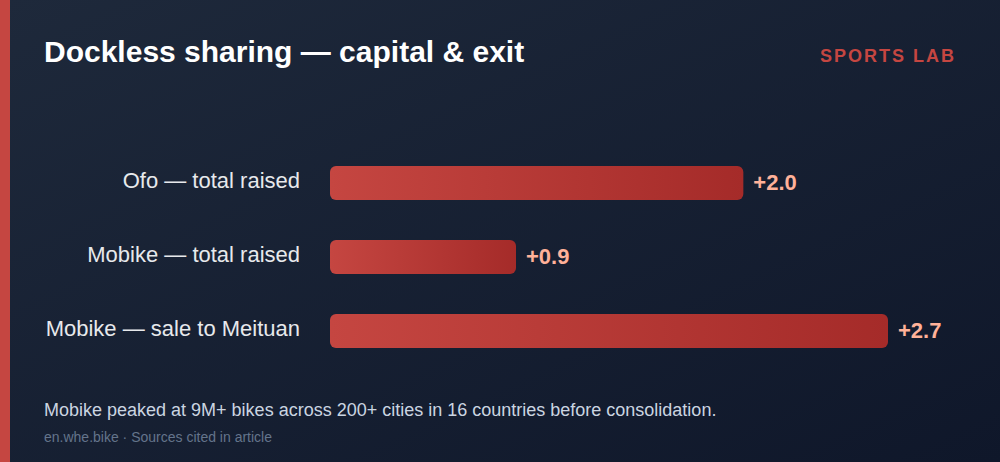
Dockless sharing — capital raised and exit value ($bn).
How the boom worked
The model was seductively simple: flood cities with GPS-tracked, app-unlocked bicycles, subsidised by venture capital, and capture the urban short-trip market. Growth was explosive because the capital was essentially free and the unit count — bikes deployed, cities entered — was the metric investors rewarded. Ofo raised over US$2 billion; Mobike raised around US$900 million and at its peak operated more than 9 million bikes across over 200 cities in 16 countries. Smaller players raised tens of millions on the same logic. The land-grab was measured in bikes dumped onto streets, not in profit.
Why it broke
The economics never closed. Bikes were damaged, stolen, abandoned, or simply piled up as waste — Wukong Bicycle, a smaller Chinese operator, reportedly lost 90% of its fleet within months of launch in 2017. Maintenance costs were far higher than the models assumed; revenue per ride was far lower. When venture capital tightened, the absence of unit economics became fatal. Companies collapsed; cities were left managing mountains of discarded bicycles — the striking 'bike graveyards' that became the defining image of the episode, a literal monument to capital deployed without a viable model.
The lasting lessons
First, hardware-as-a-service only works if the hardware is durable and the service economics are real, not assumed on a spreadsheet. Second, growth funded by investors who reward deployment volume rather than unit profitability produces exactly the waste this episode produced — and the bill eventually arrives. Third, cities learned to regulate shared systems before they are flooded, which now shapes the terms on which every subsequent micromobility operator can enter a market. The boom-and-bust was expensive tuition for everyone, including the regulators.
What survived
The collapse did not kill bike-sharing; it killed the undisciplined version of it. Mobike was ultimately sold for around US$2.7 billion to Meituan, consolidating into a platform rather than disappearing. The operators that remain are more measured — docked or hybrid systems, fleet caps imposed by cities, real maintenance budgets, and sustainable unit economics built around integration with transit and delivery platforms rather than pure venture subsidies.
Why it still matters
The episode remains the reference case for every hardware-as-a-service play in mobility, including the cargo and fleet e-bike businesses now emerging. The instinct to chase deployment metrics on cheap capital is permanent; the dockless bust is the cautionary data point that, periodically, restrains it. The industry that emerged is more durable for having hosted the experiment — and the cities it operates in are wiser regulators, which is ultimately what makes sustainable shared micromobility possible at all.
Sources: CKGSB Knowledge; BBC; SCMP; Bloomberg; Wired; The Guardian.
專欄作者
多位作者輪流主筆,從產業、賽事、市場與技術角度,提供不被規格表綁住的分析視角。
