

Shimano's 43% Profit Slump and What It Signals for the Whole Industry
When the world's biggest component maker reports a double-digit profit collapse, it is not Shimano's problem alone. It is the industry's thermometer — and the same margin trap keeps snapping shut every cycle.

When Shimano — the company whose drivetrains sit on the majority of the world's bicycles — reports a sharp collapse in profit, the headline number is never really about Shimano. It is a reading of the entire industry's temperature. And the striking thing, looking across cycles, is how reliably the same pattern recurs.
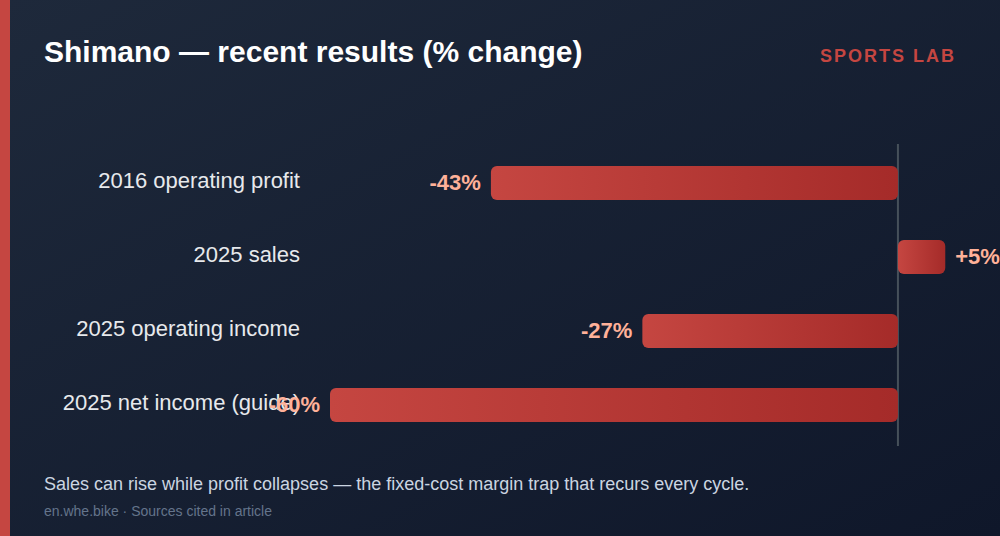
Shimano — recent results (% change).
Why Shimano is the proxy
Shimano's components flow into nearly every segment: mass-market commuters, premium road, mountain, and the e-bike category where its mid-drive systems are dominant. That breadth makes its results a lagging but exceptionally reliable index of global bicycle demand. When inventories bloat across the channel, Shimano feels the order freeze first and deepest, because it sits at the very top of the supply chain.
The recurring number
The pattern is visible across years. In 2016, Shimano reported operating profit down around 43% for the first nine months as a post-boom inventory correction hit. Years later, in its 2025 results, the company posted rising bicycle sales — up around 5% through three quarters — even as operating income fell roughly 27% and net profit fell by a far larger margin, with full-year guidance pointing to operating profit down near 30% and net income down around 60%. The headline percentages shift; the mechanism does not.
The inventory story underneath
These slumps are driven less by collapsing end-consumer demand than by brutal inventory correction. During booms, the entire channel — brands, distributors, retailers — over-orders to secure supply. When demand normalises, that stock has to clear before new orders resume. Shimano, as the upstream supplier, bears the whiplash: order books collapse not because riders stopped riding, but because the pipeline is full.
The margin mechanics
Component manufacturing is capital-intensive. Fixed costs — factories, tooling, R&D, headcount — do not flex downward quickly. When volumes fall, capacity utilisation drops and unit costs rise, compressing margin even before price competition enters. A large profit decline is simply the arithmetic of high fixed costs meeting a thin order book. Mix in price pressure as the channel discounts to clear inventory, and the margin squeeze compounds.
Why it keeps happening
The reason the trap snaps shut every cycle is structural. The industry's long lead times and optimistic ordering mean every boom over-fills the pipeline, and every correction hits the upstream supplier disproportionately. Shimano, being the largest and most exposed, is the most visible victim — but every component maker lives the same dynamic.
What it signals
For the rest of the industry, Shimano's numbers confirm that the post-pandemic hangover was real and broad, not a brand-specific stumble. They also offer a leading indicator: a resumption of Shimano orders is the first credible sign that the channel has cleared and brands are building again. Until that signal turns, everyone downstream is still working off the same glut — and the same margin trap stays armed.
Sources: Shimano financial results; Bicycle Retailer; Micromobility.io; road.cc (2016–2026).
專欄作者
多位作者輪流主筆,從產業、賽事、市場與技術角度,提供不被規格表綁住的分析視角。