
The KKR Acquisition of Accell: Private Equity Bets Big on European Cycling
KKR took Accell private for €1.56 billion in 2022 — the largest deal in cycling's history. Three years later it had written off roughly €1.1 billion in equity and ceded control to lenders. A boom-era bet that met cyclical reality.
The take-private of Accell Group by a KKR-led consortium, announced on 24 January 2022 and valued at roughly €1.56 billion (about US$1.77 billion), was one of the largest transactions in cycling's history. It was also, in retrospect, a defining cautionary tale about what happens when boom-era assumptions meet cyclical reality.
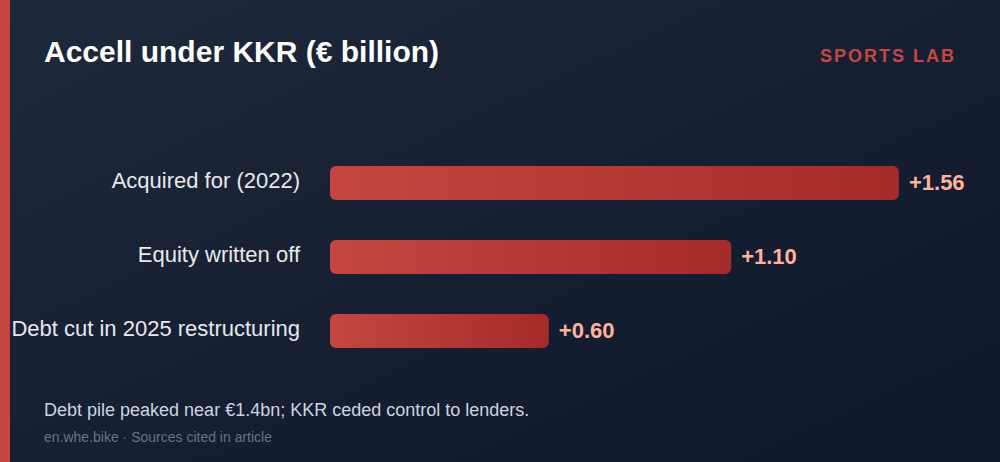
Accell under KKR: acquisition, write-off and debt restructuring (€bn).
The asset that was bought
Accell was not a single brand but a portfolio: Sparta, Batavus, Haibike, Ghost, Winora, Raleigh, Lapierre, Babboe and more. That breadth — spanning commuter, e-MTB, performance, and cargo — was precisely the appeal. The buyer acquired a platform covering most segments of the European market in a single transaction, at €58 per share, a 26% premium to the pre-bid price. The consortium intended to delist Accell from the Amsterdam exchange and run it with private capital, free from quarterly earnings pressure.
The thesis, and why it looked reasonable
The deal closed near the peak of the pandemic bicycle boom. The thesis was that European cycling had a structural floor — that modal shift, e-bike adoption, and sustainability policy would underpin durable demand even after the pandemic surge faded. Accell, as the continent's largest e-bike player by volume, looked like the purest expression of that thesis. Taking it private was meant to give KKR the runway to streamline the portfolio, rationalise brands, exit loss-making geographies, and emerge with a leaner, more profitable business.
How it unravelled
The thesis met a brutal combination. Demand normalised harder and faster than expected as the pandemic boom inverted into a deep inventory correction. Accell's North American operations had been chronically loss-making and required divestiture. Recalls — most prominently a major safety recall around its Babboe cargo-bike brand — imposed unplanned costs and reputational damage. The heavily leveraged capital structure, sized for boom cash flows, became unsustainable as revenue softened and working capital tied up in bloated inventory drained the business.
By early 2025 the consequences were stark. KKR had written off roughly €1.1 billion in equity, and Accell closed a restructuring deal that cut around €600 million from a debt pile that had reached roughly €1.4 billion, with control passing to the lenders. The owner of Raleigh, Lapierre and Babboe had, in effect, been handed back to its creditors. What was billed as a growth bet had become a distressed-credit workout.
What the episode teaches
The Accell saga carries several lessons that now shape how the industry thinks about consolidation. First, a portfolio of acquired goodwill priced for permanently elevated demand is fragile; when demand mean-reverts, the accounting catches up violently, and leverage amplifies the damage. Second, scale bought through acquisition concentrates exposure — a single shared supply chain, one inventory cycle, and one demand shock propagate across every brand in the stable. Third, the bicycle business is more cyclical and more working-capital-intensive than consumer-electronics logic assumes, and capital structures built on the latter assumption break on the former.
What it means for the industry
The deal normalised large-scale financial ownership of cycling brands, but its unhappy ending has made subsequent capital more disciplined. The mid-tier of European cycling — brands too small to compete globally alone, too established to disappear — remains prime territory for roll-up, but buyers now price assets on normalised, through-cycle demand rather than peak boom rates, and they structure deals with more room to absorb a downturn.
The Accell transaction did not just change one company's ownership. It reset the risk model for every subsequent consolidation play in cycling — a template whose warning, paid for in roughly a billion euros of written-off equity, the rest of the industry has absorbed.
Sources: Accell Group / KKR joint press release (Jan 2022); Reuters; Cycling Industry News; transacted.io; AFR (2025 restructuring).
專欄作者
多位作者輪流主筆,從產業、賽事、市場與技術角度,提供不被規格表綁住的分析視角。