

Cambodia's Billion-Dollar Bicycle Exports and the Geography of Diversification
Cambodia's bicycle exports swung from $966 million in 2022 to under $430 million in 2024, then rebounded. The boom-bust arc is a map of how trade policy, not efficiency, now decides where bikes are built.

Cambodia's bicycle export figures tell a story far bigger than one country: they are a live demonstration of how trade policy, rather than manufacturing efficiency, now dictates where the world's bicycles are built — and how volatile that arrangement is.
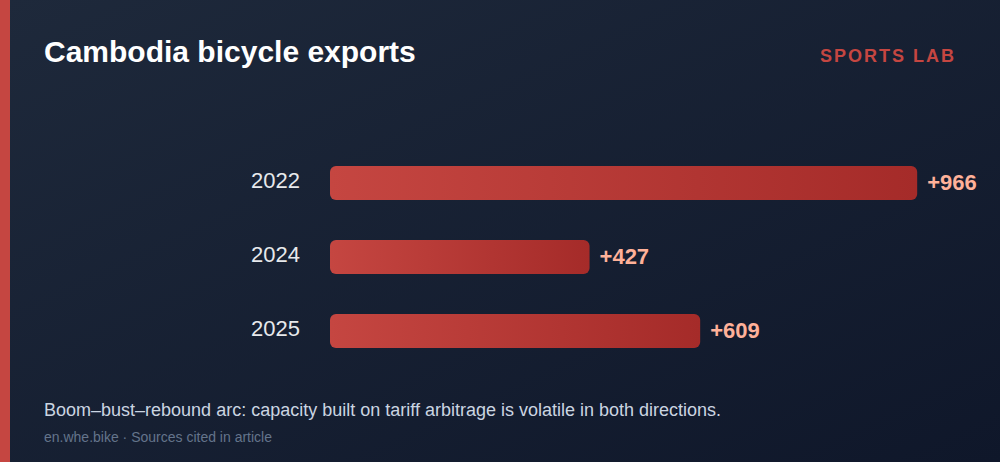
Cambodia bicycle exports (US$ million).
The arc
The numbers swing dramatically. Cambodia's bicycle exports hit roughly US$966 million in 2022, up 48% year-on-year, shipped to more than 50 countries across the EU and the US. Then the correction hit: by 2024 exports had fallen to around $427 million. They rebounded to roughly $609 million in 2025, a rise of over 40%. That is not the profile of a stable manufacturing base finding its level — it is the profile of a supply route expanding and contracting with the tariff and demand environment around it.
Why Cambodia grew
Cambodia built a meaningful bicycle export industry largely because of preferential trade terms. Everything-but-arms treatment and preferential arrangements made it a tariff-advantaged origin for exports to the EU and elsewhere. Investment followed the tariff advantage, and assembly capacity grew — to the point that Cambodia at times rivalled China as a top supplier of bicycles to the European market. The growth did not happen because Cambodia was suddenly the most efficient place to build a bicycle. It happened because the border-cost arithmetic made it the most economic landing point for export.
Why the volatility matters
This is the central lesson. Production built on tariff arbitrage is mobile in both directions. When demand softens or when preferential terms come under review — through graduation, rule-of-origin tightening, or geopolitical shifts — the advantage erodes quickly, and the capacity built to exploit it sits underutilised. The swing from near a billion dollars to under half a billion and back is the arithmetic of a supply base whose viability depends on policy decisions made in Brussels and Washington, not in Phnom Penh.
The wider pattern
Cambodia is one node in a broader Southeast Asian diversification of bicycle supply, alongside Vietnam and Thailand. The pattern is consistent across all of them: capacity follows the border-cost calculation. For brands, the takeaway is that origin is now an active variable in product strategy, and a single policy change — a tariff, a preference review, a trade deal — can redraw sourcing maps faster than most planning cycles can react.
The strategic read
For the industry, the implication is sobering. The diversification away from China that trade policy has forced is real and probably durable, but the specific countries that benefit from it are not guaranteed. Brands building long-term capacity in any single preferential origin are making a bet on that origin's trade terms holding — a bet that Cambodia's boom-bust arc shows can reverse sharply. The resilient strategy is not to pick the next tariff winner, but to hold optionality across several origins, accepting that the map will keep moving.
Sources: Xinhua; Khmer Times; Bike-EU; Fresh News Asia (2022–2025).
專欄作者
多位作者輪流主筆,從產業、賽事、市場與技術角度,提供不被規格表綁住的分析視角。