
Europe Doubles Down: EU Extends Anti-Dumping Duties on Chinese E-Bikes
Extended to 2030, with combined duties up to 79.3%, the EU's e-bike tariff wall is now permanent infrastructure. It protects assembly jobs — and quietly reshapes who can sell electrified mobility in Europe.
In January 2025 the European Commission confirmed a five-year extension of anti-dumping and countervailing duties on electric bicycles from China, pushing the regime out toward 2030. Read as routine trade-housekeeping, it misses the point. The extension converts what was once a temporary defence into permanent European industrial infrastructure.
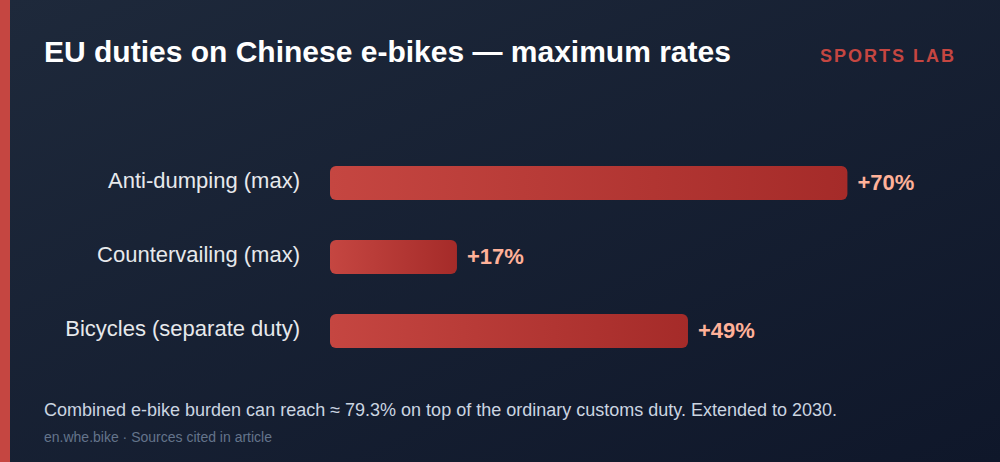
EU duties on Chinese e-bikes — maximum rates (extended to 2030).
The numbers in the wall
The extended regime carries real weight. Anti-dumping duties range from 10.3% to 70.1%, layered with countervailing duties of 3.9% to 17.2% — a combined burden that can reach 79.3% on top of the ordinary customs duty. The complaint was brought by the European Bicycle Manufacturers Association (EBMA), representing producers who argued that Chinese e-bikes were being sold below cost and would again be dumped if the measures lapsed. The Commission's expiry review agreed: lifting the wall would likely allow injury to recur.
This sits alongside a separate, older 48.5% anti-dumping duty on conventional Chinese bicycles. Together they form a tariff architecture that makes China-origin two-wheelers structurally expensive at the European border.
What the wall actually defends
The conventional framing — protecting European manufacturing jobs — is only partly right. The deeper stake is who controls the price floor of electrified mobility on the continent. Chinese e-bike supply chains benefit from integrated battery, motor and frame production at a scale Europe cannot match. Without a tariff wall, the European assembly model — concentrated in Poland, Portugal and Germany, and increasingly in plants set up by Asian brands inside the EU — erodes quickly. The duties buy time for that assembly base to mature into something self-sustaining.
The circumvention arms race
A wall only works if people do not route around it, and routing is exactly what has happened. The Commission formalised this with Regulation (EU) 2020/1140, which re-imposed duties on bicycles assembled from Chinese-origin parts, and extended the duties to the components themselves — closing the loophole of importing parts and screwing the bike together inside the EU. The Commission has had to extend anti-circumvention measures to e-bike components, because assembling a near-finished bike from Chinese parts inside the EU became a way to dodge duties meant for whole bikes. Producers have also shifted final assembly to Vietnam, Cambodia and Thailand, and to EU-based joint ventures. LEVA-EU, representing European e-bike importers and assemblers, has argued forcefully that duties on components hurt the very European SMEs the policy claims to protect — an internal split within the European industry that the Commission resolved in favour of producers.
The consumer-welfare counter-argument
The sharpest criticism is that duties keep e-bike prices high precisely when climate and transport policy wants people out of cars. A 79.3% combined burden on the cheapest imports means the most price-sensitive would-be riders face the steepest cost. There is genuine tension between industrial policy and modal-shift policy here, and the Commission has chosen the former. Whether that compounds into slower e-bike adoption than Europe's decarbonisation targets require is a question the next five years will answer.
The strategic read
The extension is not a solution; it is a moat. Whether anyone is building a castle behind it — competitive European e-bike brands with genuine technology, service and brand equity — is the open question. The duties protect margin and time; they do not create competitiveness. European producers now have until roughly 2030 to convert protection into capability. If by the next expiry review European e-bikes still cannot stand on their own, the cycle of extension simply repeats — and the political cost of protecting an industry that never matured rises.
For everyone downstream — importers, retailers, fleets, and riders — the practical reality is a two-tier European market: protected, pricier EU-assembled product, and Asian product that carries the cost of the wall at the border or the cost of re-routing around it.
Sources: European Commission, EU Trade (policy.trade.ec.europa.eu, Jan 2025); LEVA-EU; EBMA; Commission Implementing Regulation (EU) 2025/120.
專欄作者
多位作者輪流主筆,從產業、賽事、市場與技術角度,提供不被規格表綁住的分析視角。