
The 15% Ceiling: What the US-Taiwan Tariff Deal Actually Secures
From a 32% shock in 2025 to a 20% interim rate to a 15% ceiling in early 2026 — the US-Taiwan deal did not cut tariffs so much as insure Taiwan's bicycle exporters against the worst case.
The US-Taiwan reciprocal trade agreement that capped the US tariff on Taiwanese goods at 15% was received as good news for the island's exporters. It was — but the mechanism matters more than the headline, and the path to it reveals just how much damage had to be absorbed first.
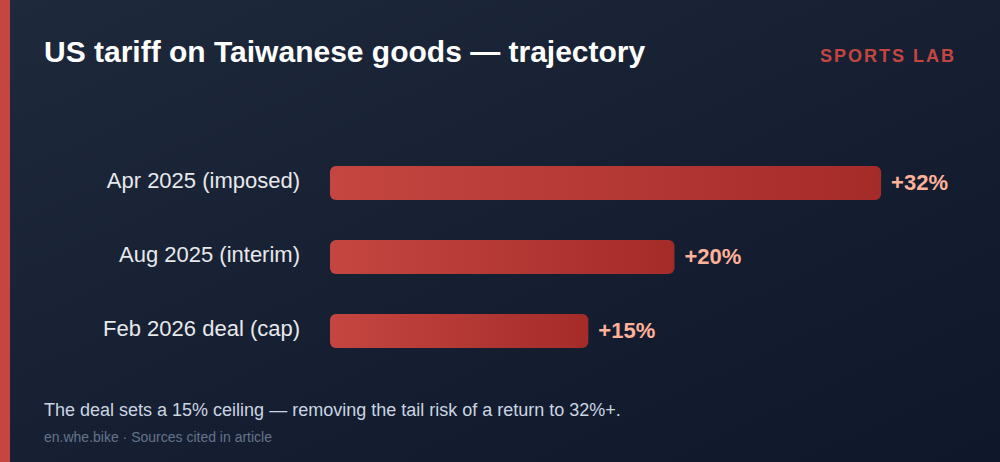
US tariff on Taiwanese goods — from 32% to a 15% cap.
The trajectory: 32 to 20 to 15
The 15% ceiling did not appear from nowhere. It was the endpoint of a volatile sequence. In 2025 the Trump administration imposed a 32% reciprocal tariff on Taiwanese goods — a rate that, combined with the pre-existing base duty, pushed a Taiwanese bicycle to a roughly 43% total tariff at the US border. That shock triggered months of disruption: front-loaded shipments, frozen orders, hesitant US customers. An interim 20% rate followed later in 2025. The eventual deal, finalised in early 2026, set a unified 15% all-in US tariff on Taiwanese goods — reducing, though not eliminating, the 32% that had been imposed.
A cap, not a rate
The crucial detail is that the agreement sets a ceiling, not a fixed rate. Below 15%, US tariffs on Taiwan can still move with whatever trade policy the moment demands. What the deal removes is the tail risk — the possibility of a return to 30% or 40% that would have made Taiwanese bicycles structurally uncompetitive in the US. For an industry that plans in seasons and commits tooling years ahead, removing the worst-case scenario is worth more than any single rate reduction.
Why it mattered so much for bicycles
Taiwan's bicycle industry is export-dependent to a degree few sectors are. The companies behind most premium frames and groupsets sold globally ship a large share of their output to North America. A worst-case tariff would have cascaded through the entire Taichung cluster — not just the big brand names but the tiers of component makers, finishers and subcontractors that depend on them. The cap converted an existential threat into a manageable, if unwelcome, cost.
In exchange, Taiwan agreed to eliminate or reduce tariff barriers on roughly 99% of US goods and to open its market — including to US automobiles. The bicycle industry's security was bought with concessions made across the rest of the Taiwanese economy.
The trade-off: stability bought with flexibility
A ceiling protects volume but does nothing for margin pressure at the 15% level. It also locks both sides into a negotiating frame: future US demands for further concessions now run against an agreed limit, and future Taiwanese requests for deeper reductions run against a US preference to keep the rate as policy leverage. That is stability of a kind, but it is stability purchased with flexibility on both sides.
The strategic signal
For the rest of the industry, the takeaway is that Taiwan retains its preferred position in the US market — not because it is the cheapest origin, but because its trade relationship is now explicitly ring-fenced by treaty. Competing origins can be cheaper; few can be as politically secure. For US buyers, that means Taiwan remains the reliable premium source, while Southeast Asian origins absorb the cost-sensitive volume that the 15% ceiling still makes expensive to route through Taipei.
Sources: USTR fact sheet on US-Taiwan agreement; CRS (IF10256); Taiwan CIER analysis; BowerGroupAsia Taiwan Tariff Tracker.
專欄作者
多位作者輪流主筆,從產業、賽事、市場與技術角度,提供不被規格表綁住的分析視角。