
When the Tariffs Hit Home: The 2025 Shock to the US Bike Industry
A 32% tariff on Taiwan and combined rates above 80% on China did not just raise prices. They forced a rewrite of every sourcing contract signed in the last decade — and tested whether the US even has a bicycle market worth supplying.
The tariff wave that broke over the US bicycle industry in 2025 was on a different scale from anything that came before. Where Section 301 had imposed a 25% layer on Chinese e-bikes, the 2025 measures imposed a 32% reciprocal tariff on Taiwanese goods and a 34% rate on Chinese goods, with combined duties on some Chinese bicycles exceeding 80%. For a US market in which the vast majority of bicycles are imported — and in which Taiwan and China together account for the lion's share of frames and components — this was an existential policy shock, not a pricing inconvenience.
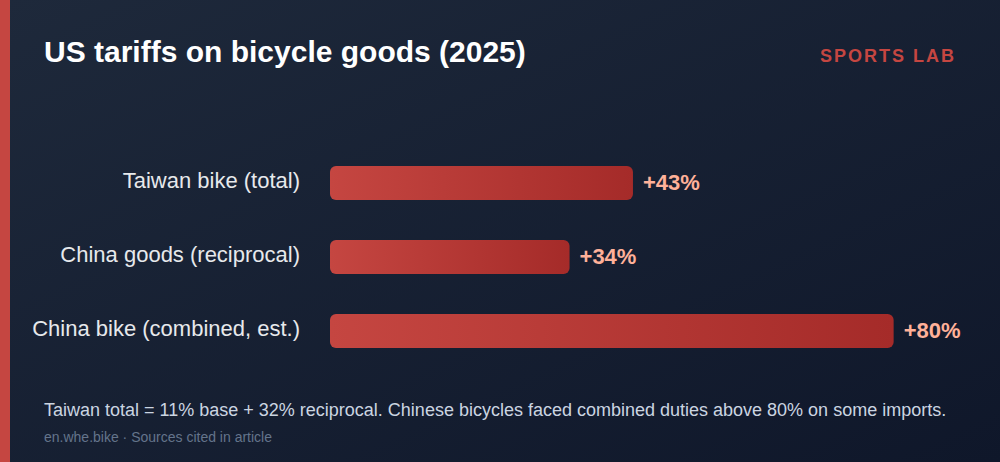
US tariffs on bicycle goods, 2025.
The arithmetic of a 43% Taiwanese bike
The numbers compounded brutally. A bicycle imported from Taiwan now carried a total tariff of roughly 43% — the pre-existing 11% base duty plus the new 32% reciprocal layer. For premium brands whose entire range flows out of Taichung, that is not a margin problem; it is a structural reset of what the product can cost. PeopleForBikes, the US industry body, walked through the arithmetic publicly, and the conclusion was unavoidable: the cost had to reach the consumer, the retailer, the brand, or all three.
The scramble before the cliff
The immediate industry response was rational and frantic. With an effective date looming, the entire channel rushed shipments ahead of it — front-loading an entire season's inventory, pulling orders forward, and booking freight at premium rates. Taiwan's manufacturers reported customers racing to meet orders before the wall went up. That bought months of supply, but it created a lumpy, expensive inventory position that retailers and distributors would carry deep into the following year, distorting cash flow and order patterns.
Pricing as the only remaining lever
When front-running ran out, price increases followed. Major Taiwanese brands raised US prices — 10% moves were visible across the industry — as the cleanest signal that border cost had to reach the rider. The real question was never whether prices would rise, but how much of the increase the US consumer would absorb before demand bent. With bicycle demand already soft coming out of the post-pandemic correction, layering double-digit price increases on a fragile market risked compounding the downturn.
The deeper damage: the death of lead-time planning
The most corrosive effect was not on price but on certainty. Bicycle sourcing operates on long lead times; frames and components are ordered seasons ahead, with tooling commitments that cannot be reversed. A tariff regime that can move by double digits between the moment an order is placed and the moment the container clears customs makes a mockery of standard forecasting. Brands that had spent a decade optimising just-in-time supply were suddenly forced back into speculative inventory building — ordering more, earlier, to hedge a policy environment that changed weekly.
The structural fallout
The industry's real adaptation is not the next price increase. It is the slow, expensive diversification of supply away from single-origin dependency — toward Vietnam, Cambodia, Thailand, and the distant possibility of assembly closer to home. The 2025 shock did not invent that shift, but it converted it from strategic optionality into operational necessity. The 32% on Taiwan also reshaped the political economy: it is what eventually produced the US-Taiwan deal capping the rate at 15% — a ceiling bought with two years of disruption.
For an industry that had spent five years absorbing one shock after another — pandemic, inventory correction, soft demand — 2025 was the year that trade policy stopped being a variable brands could plan around and became the variable that planned them.
Sources: PeopleForBikes tariff updates; France24; Taipeitimes; industry trade press (2025).
專欄作者
多位作者輪流主筆,從產業、賽事、市場與技術角度,提供不被規格表綁住的分析視角。