
Ninety Days of Air: The US-China Tariff Pause and What It Bought
In May 2025 the US and China cut reciprocal tariffs by 115 percentage points each. It was reported as de-escalation. For the bicycle trade it was a starting gun — and a deadline.
On 12 May 2025, after talks in Geneva, the United States and China announced that each would reduce tariff rates on the other's goods by 115 percentage points for a 90-day window. US tariffs on Chinese goods dropped from 145% to 30%; China's tariffs on US goods dropped from 125% to 10%. It was reported as a de-escalation, even a thaw. For the bicycle industry, it was closer to a starting gun.
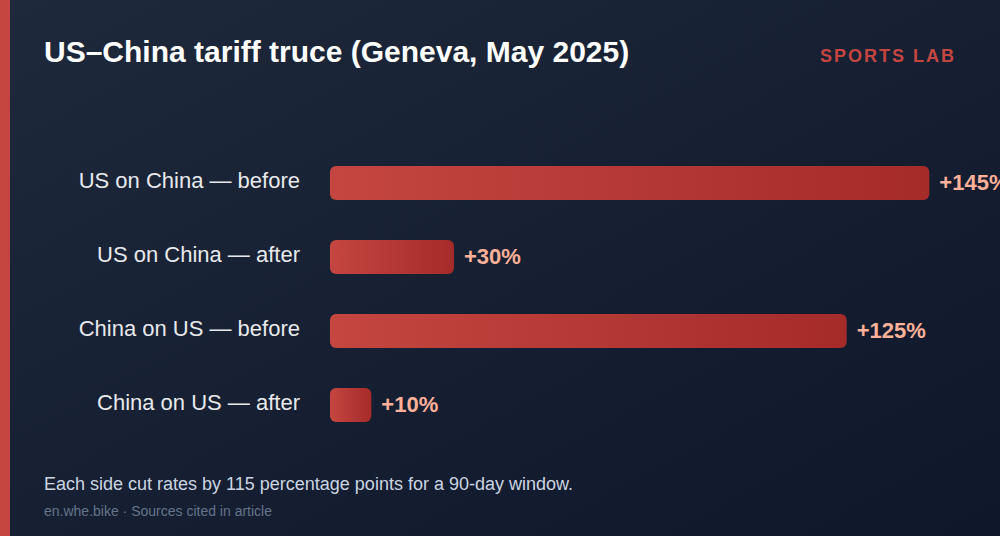
US–China tariff truce, Geneva May 2025.
What the pause actually changed
For a fixed window, the effective tariff burden on many bicycle products fell sharply. That lowered landed cost and widened margin — briefly. Importers with working capital and container capacity moved quickly to capture the difference; those locked into longer contract terms, or without the logistics flexibility to accelerate, did not. The benefits accrued to the fast and the liquid.
The fundamental backdrop did not change. A 30% US tariff on Chinese goods is still historically high; it is simply less catastrophic than 145%. The bicycle products most exposed to the original spike — frames, components, finished e-bikes — remained expensive at the border in absolute terms. The truce lowered the temperature without restoring normality.
The behavioural response: a rush, not calm
The pause did not produce calm. It produced a rush. Any importer who could push orders into the window did so, gambling — rationally — that rates would be worse on the other side. Inventory built up; freight patterns distorted; the industry front-loaded demand it had not yet seen at the retail level. The 90-day window functioned less as relief and more as an arbitrage opportunity with a hard expiry.
This is the perverse mechanics of a temporary tariff cut. A permanent rate, however high, lets a business plan. A temporary cut creates a deadline. Investment in alternative sourcing slows during the window, because the cheaper route is temporarily open again and the payback on diversification looks worse. Then the window closes and the diversification that was paused has to restart from behind — having lost months of lead time precisely when it was most needed.
Why a pause can be worse than a status quo
The deeper problem is credibility. Trade policy only functions as a planning input if businesses believe the rules tomorrow will resemble the rules today. A regime that swings between 145% and 30% on the strength of a single meeting teaches the market that the rules are noise. The rational response to noise is not calm optimisation; it is hoarding — of inventory, of cash, of optionality. Every brand that lived through the 90-day truce emerged with thicker buffers and thinner trust in forward guidance.
The honest read
The Geneva truce was not a solution; it was an intermission. The brands that used it to lock in multi-origin contracts and renegotiate longer-term terms came out ahead. The brands that simply enjoyed the cheaper imports for a quarter — treating the window as a windfall rather than a warning — set themselves up for the next shock when the pause expired and the rates snapped back toward their prior levels.
For an industry that had already learned, through Section 301 and the 2025 reciprocal tariffs, that trade policy is now a core input, the 90-day truce was one more data point in the same lesson: in a regime this volatile, the only durable strategy is a supply chain that does not depend on any single tariff outcome.
Sources: White House joint statement (May 2025); Gibson Dunn analysis; China-Briefing; World Economic Forum tariff timeline.
專欄作者
多位作者輪流主筆,從產業、賽事、市場與技術角度,提供不被規格表綁住的分析視角。