
Green Shoots or False Spring? ZIV Sees the German Market Recover
Germany's ZIV reports an 11% Q1 sales rebound to 885,000 units. It is the industry's first credible sign that the bottom may hold — credible, not yet certain.

When Germany's ZIV industry association reported early signs of recovery in the bicycle and e-bike market, it was a moment worth taking seriously — and reading carefully rather than celebrating.
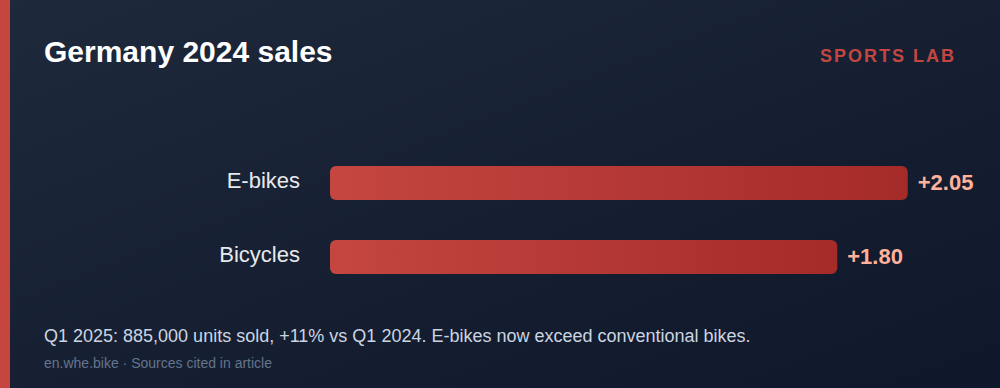
Germany 2024 sales (millions of units).
Why Germany matters
Germany is Europe's largest bicycle market and a global bellwether for e-bike adoption. A recovery signal here carries far more weight than noise from smaller markets. ZIV's data, drawn from member companies across the supply chain, is among the more reliable reads on real sell-through to end customers, not merely factory shipments.
The numbers behind the optimism
The figures are concrete. In the first quarter of 2025, German sales of bicycles and e-bikes reached roughly 885,000 units — an increase of nearly 11% over the 800,000 sold in the same period of 2024. For 2024 as a whole, the market moved around 3.85 million vehicles, of which roughly 2.05 million were e-bikes — a figure only modestly below prior years despite the broader correction. The decline, in other words, was real but shallow, and the e-bike share kept climbing.
What 'recovery' actually means
The optimism is relative. It follows a steep post-pandemic correction in which bloated inventories were worked down and demand normalised from boom peaks. 'Recovery' here does not mean a return to 2020–21 volumes; it means the decline has flattened and the channel is buying again. A market that sold fewer total units but a higher proportion of expensive e-bikes can still be stable or growing in value even as unit counts drift.
The e-bike engine
E-bikes are doing the heavy lifting. While conventional bicycle sales remain subdued, e-bike adoption — driven by commuter substitution, an ageing rider base, and cargo-bike growth in urban logistics — continues to expand. The market is not growing uniformly; it is shifting compositionally toward electrified products, and Germany's production and sales data both confirm that shift is structural, not cyclical.
Cautious by necessity
ZIV's tone is rightly hedged. A recovery built on e-bikes depends on disposable income, financing availability for premium purchases, and stable supply — any of which can wobble. But after two years of contraction, a flattening, let alone an 11% quarterly turn, is the first credible indication that the industry's floor is real. The question now is the slope of the recovery, not its direction.
Sources: ZIV (ziv-zweirad.de) market data 2024/2025; Bike-EU; Cycling Industry News.
專欄作者
多位作者輪流主筆,從產業、賽事、市場與技術角度,提供不被規格表綁住的分析視角。